DECIDUOUS
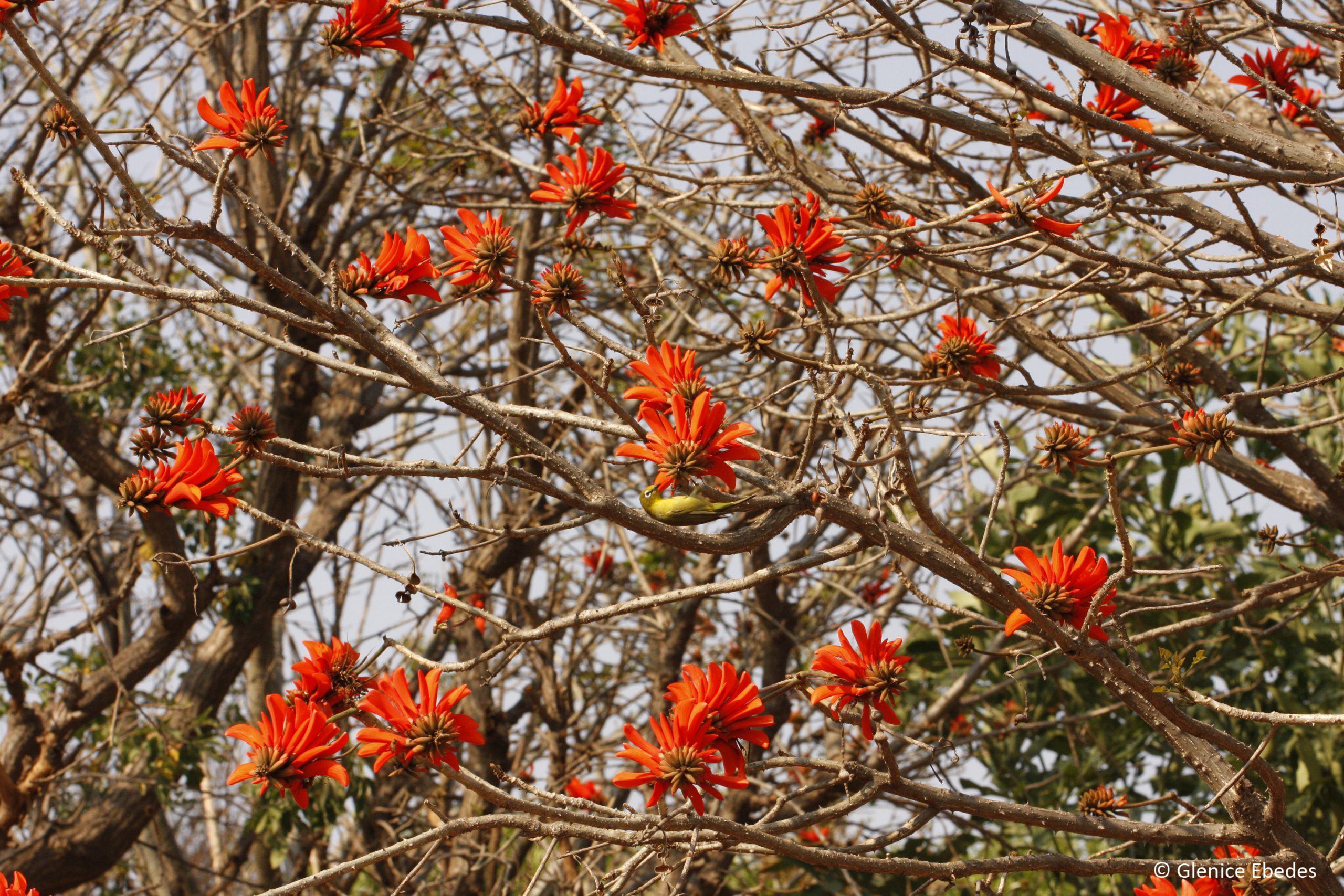
Erythrina lysistemon
Family: Papilionoideae – Leguminosae (Pea subfamily – Pod-bearing family)
Common names: Coral Tree (E); umSinsi (Z); Koraalboom (A);
Native to: Southern Africa
Tree
A deciduous tree which bears distinctive clusters of bright orange-red flowers at the beginning of spring.


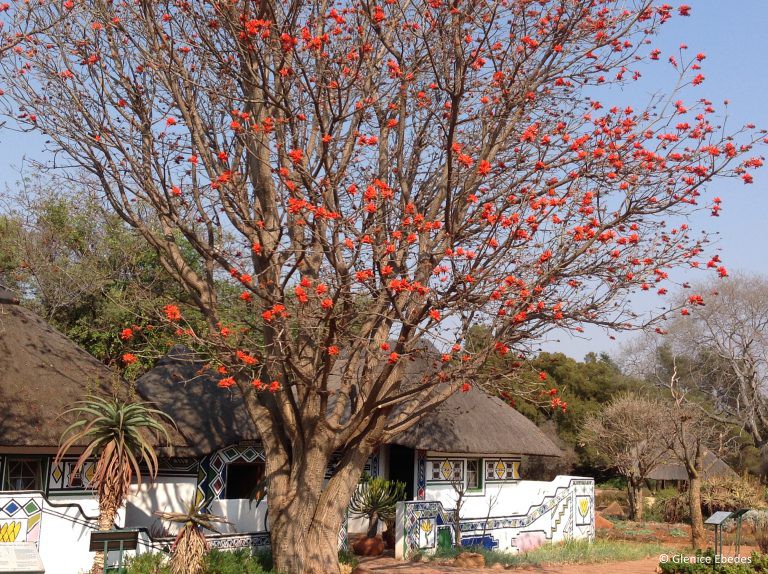
Erythrina lysistemon
FULL SUN
SEMI FROST HARDY
MEDIUM WATER REQUIREMENTS
MEDIUM GROWER
ATTRACTS BIRDS
ATTRACTS INSECTS
FLOWER COLOUR:
AVERAGE SIZE:
10m x 8m
FLOWERING TIME:
J F M A M J J A S O N D
FRUITING TIME:
J F M A M J J A S O N D
Erythrina lysistemon
DESCRIPTION
An attractive deciduous tree with a dark grey bark. The trifoliate leaves are light green. The tree bears beautiful, scarlet flowers bone in short dense heads on long stalks. The fruit is a slender, black pod that is constricted between the seeds. The pods split open to release bright red, hard cased seeds with a black eye.
NATURAL HABITAT & DISTRIBUTION
Scrub forest, woodlands and grasslands.WILDLIFE & ECOLOGICAL BENEFITS
The flowers are rich in nectar and attract a variety of birds such as Bulbuls, Sunbirds, Mousebirds and White-eyes.The dead wood is soft and is often excavated by birds that nest in hollows like barbets, hornbills and woodpeckers.
Hollow trunks are often used to house a swarm of bees.


11 responses
Hi Ollie
Thanks for visiting Plantbook.
The bark of Erythrina lysistemon is not thick, so cutting the trunk may damage the tree or affect its stability. Without seeing the tree, it’s impossible to give any advice.
I would recommend speaking to other bee removal experts who may have encountered a similar experience.
All the best.
Flourish!
Glenice
A bee swarm is located at and beneath the base of a very large coral tree in a garden in our Little Karoo town.
The owner requests that the bees be removed.
Please advise regarding the root system which I guess is adventitious with no tap root ?
It would appear that an advisable swarm removal method would be a “Trap-out”.
Should it be necessary to cut into part of the large trunk (diameter = 0.9 meters) to better access the bees , would this cause irreparable damage to this 10 meter tall tree ?
Approximately how thick is the bark of such a large coral tree ?
What is the average anticipated size of its hollows.
This particular tree is healthy, though showing signs of some die-back on lateral branches.
Your input and advice would be much appreciated.
Hi Debbie
Thanks for visiting Plantbook.
Erythrina lysistemon is very frost sensitive so not likely to thrive in an area with severe frost as the tree may die or have very stunted growth form due to several branches dying back each winter.
I do not think the seeds will be an issue with the buck but note that it has an aggressive root system so it’s best not to plant less than 12m from any structure.
Flourish!
Glenice
Good Day,
I would like to plant this tree in our new garden at Hartbeespoort – how frost tolerant is it? also how big does it grow and what is its growth rate.
I can buy a plant that is 3M Hight stem of 50mm
We have buck in the estate I see it mentioned the seeds can be poison, I assume that the buck will not eat it?
Hi Cynthia
Thanks for visiting Plantbook.
Erythrina lysistemon is not naturally found in your area so you’ve set yourself a bit of a challenge getting it to thrive in your environment.
The trees favour a summer rainfall climate as they require a dry dormant period (winter) in order to flower abundantly in spring.
They require a position in full sun and well-drained soil. The coastal winds are not helpful either.
Mealy bugs tend to attack plants that are stressed, so this is not the cause, but the result of your tree struggling in the environment.
Flourish!
Glenice
Hi there
I live close to the coast in Cape Town and we planted an erythrina lysistemon just before winter. It wintered well but due to a neighbours windbreak gets very little sun. We are negotiating with the neighbours to reduce their windbreak so the tree will receive winter sun however the tree has sprouted leaves all over which now seem to be dying back. They’re not a bright green but rather a little yellow, many are dying back and falling off. It seems slow to generate full size leaves too. Do you think this is all due to getting no sun for four months or due to the coastal winds? Or just because it was recently planted and is adjusting? We also didn’t get any flowers but I’m assuming due to lack of sun over winter.
There’s also some mealy bugs and spider webs but I’m not sure they would make this big an impact on the tree.
Please help
Hi Glenice
Thank you so much for your reply, I really appreciate it tremendously. I will definitely take note of your advice with regards the root system in a pot and will make sure that the tree has sufficient nutrients and hopefully it will remain pest free whilst in the pot.
Best regards
Dee
Hi Dee
Thanks for visiting Plantbook.
Erythrina lysistemon is grown as a bonsai specimen so can be grown in a planter. Note however that the art of bonsai involves trimming both the roots and branches to control the growth of the plant.
As Erythrina lysistemon has an aggressive root system you may find that it will break your pot at some stage. Also remember to raise your planter at least 10cm above the ground and monitoring the base frequently to avoid the roots growing through the drainage holes as they will try to escape to an unlimited supply of nutrients.
Remember that a planter is an artificial environment with limited nutrients and microorganisms which could make your tree may be more susceptible to pests and diseases which could affect its growth and lifespan.
Flourish!
Glenice
Hi Glenice
What wonderful information on the Coral Tree.
I’d like to know whether it is possible to grow one in a large pot and prune it to remain fairly small in size or would this not work due to the aggressive root system?
Regards
Dee
Hi Sandra
Thanks for visiting Plantbook.
In answer to your question on the best time to plant, there’s a Chinese proverb: “The best time to plant a tree was 20 years ago, the second best time is now.”
Erythrina lysistemon requires a large space and has a very aggressive root system, so needs to be at least 10 metres from any structure. Their spectacular spring display makes them a fantastic plant to use for a focal point in a garden. It is best suited for a summer rainfall climate.
It is deciduous, so will lose its leaves in winter. It is best to avoid watering it in winter to allow it to go dormant. We’ve found that trees that receive very little water in winter produce an abundance of flowers in spring whereas trees that are continually watered in winter may not lose their leaves and may not produce any flowers.
Flourish!
Glenice
when is the best time of the year to plant the erythrina lysistemon. and also where. can one plant this type of tree?